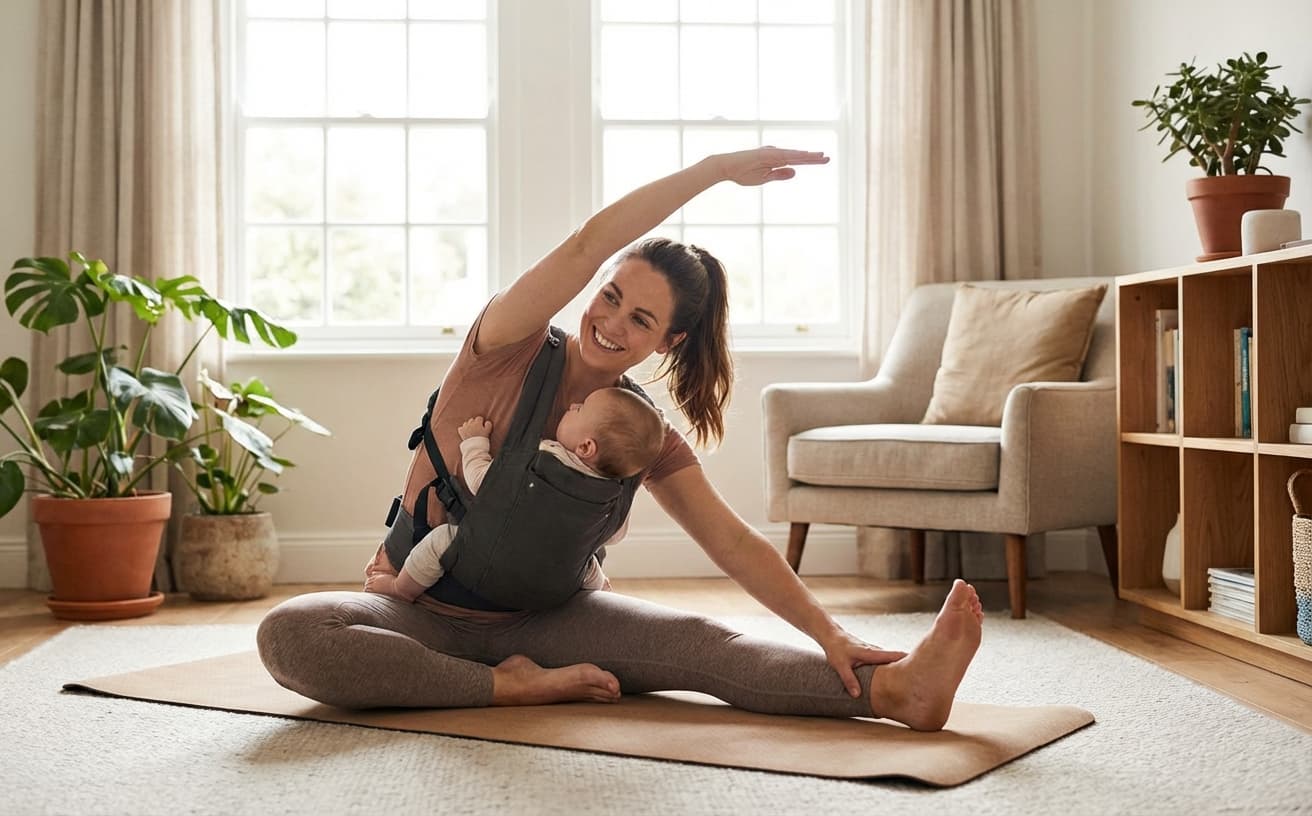
Postpartum Core Exercises for Beginners: Your Step-by-Step Guide to Healing Strong

Why Postpartum Core Exercises for Beginners Are Different From Regular Workouts
If you've ever Googled “how to get my abs back after baby,” you've probably been bombarded with advice about crunches, planks, and intense core circuits. Here's the truth: most of that advice is exactly wrong for a postpartum body — at least in the beginning.
During pregnancy, your abdominal muscles stretch dramatically to accommodate your growing baby. Your pelvic floor takes on increased pressure for months. Hormones like relaxin soften your connective tissue. And if you had a C-section, you're also healing a significant surgical incision through multiple layers of tissue.
Starting postpartum core exercises for beginners the right way means working with your body's healing process, not rushing past it. The goal in the early weeks isn't flat abs — it's rebuilding the deep internal support system that keeps your whole body stable and pain-free for the long haul.
Before You Begin: Check for Diastasis Recti
One of the most important steps before starting any postpartum core exercises for beginners is checking for diastasis recti — a separation of the two long muscles running down the center of your abdomen. This separation is extremely common during pregnancy and affects many new moms to some degree.
You can do a simple self-check at home. Here's how:
- Lie on your back with your knees bent and feet flat on the floor.
- Place your fingertips horizontally across your belly button, pointing toward your feet.
- Slowly lift just your head and shoulders off the floor, like the beginning of a crunch.
- Feel for a gap or softness between the two sides of your abdominal muscles.
If the separation feels wider than two finger-widths, you may have a more significant diastasis recti that needs targeted healing before you progress to many standard core exercises. In that case, working with a pelvic floor physical therapist is strongly recommended — they can give you a personalized plan that meets your body exactly where it is.
Even if your gap seems small, it's worth knowing about before you move forward. Some exercises that feel fine for most people can actually worsen the separation if your core isn't ready.
When Can You Start Postpartum Core Exercises?
This is one of the most common questions new moms have — and the answer is more nuanced than a single date on the calendar.
The Early Days: Gentle Activation
Gentle core activation — things like diaphragmatic breathing and pelvic floor engagement — can often begin shortly after birth, as soon as you feel comfortable doing so. These aren't exercises in the traditional sense. They're more like reconnecting with the internal muscles that support your core, which may feel disconnected or numb after delivery.
Always get medical clearance from your healthcare provider before starting any postpartum movement routine, even gentle exercises. Every birth experience is unique, and your provider knows your specific situation.
The 6-Week and 8-12 Week Milestones
More targeted postpartum core exercises for beginners — like glute bridges and heel slides — are generally appropriate starting around 6 weeks after a vaginal birth. If you had a C-section, that timeline typically extends to 8 to 12 weeks, because your body needs additional time to heal the surgical incision and deeper tissue layers.
Even at those milestones, being cleared for exercise at your postpartum checkup doesn't mean you should jump back into your pre-pregnancy workouts. It's a green light to gently begin — not a signal to go all-out.
The Long Game: 6-12 Months and Beyond
Here's something nobody tells you at your six-week appointment: it can take 6 to 12 months — or even longer — for your core and pelvic floor to regain optimum function after childbirth. That timeline varies depending on the type of birth you had, how well your tissues are healing, your hormonal balance (especially if you're breastfeeding), and many other individual factors.
That's not a reason to feel discouraged. It's a reason to be patient, consistent, and kind to yourself throughout the process. Explore more about postpartum recovery and wellness to support your whole journey.
The Star of Postpartum Core Work: Your Transverse Abdominis
Before we get into specific exercises, let's talk about the muscle that matters most in early postpartum core work: the transverse abdominis, often called the TVA.
Think of your transverse abdominis as an internal corset. It wraps all the way around your torso — from your spine in the back to the front of your abdomen — providing deep stability and support. Unlike the more superficial six-pack muscles (the rectus abdominis), the TVA works below the surface to hold everything together.
During pregnancy and after birth, this deep core muscle often becomes inhibited — meaning your brain and body temporarily lose their strong connection to it. Rebuilding that connection is the foundation of safe and effective postpartum core exercises for beginners. Everything else — bridges, planks, more advanced movements — builds on a strong TVA.
What to AVOID: Why Crunches Are Not Your Friend Right Now
Let's talk about the move most people think of first when they think about core exercises: the crunch. And the short answer is — please skip it for now.
Crunches and sit-ups create outward pressure on the abdominal wall. When you do a crunch, the internal pressure pushes against the front of your abdomen — the same area that's already weakened and stretched from pregnancy. This can cause something called doming or coning, where you see a ridge or bulge forming down the center of your belly during the exercise.
That doming is a warning sign. If you see it during any exercise — not just crunches — it means that movement is too advanced for your core right now, and you should stop and dial back. Other movements to approach with caution in early postpartum recovery include:
- Traditional sit-ups
- Double-leg lifts
- Heavy overhead lifting
- High-impact cardio before your pelvic floor is ready
- Intense planks that cause your abdomen to bulge downward
This doesn't mean you'll never do these things again. It means your body needs to rebuild its foundation first. Learn more about fitness approaches that support your whole body at every stage.
The Best Postpartum Core Exercises for Beginners
Ready for the good stuff? These exercises are gentle, effective, and designed to meet a postpartum body right where it is. Start slowly, listen to your body, and remember: quality of movement matters far more than quantity.
1. Diaphragmatic (Deep Core) Breathing
This is where everything begins. Diaphragmatic breathing reconnects you to your deep core muscles and helps re-establish the coordination between your breath, your pelvic floor, and your transverse abdominis.
How to do it: Lie on your back with your knees bent. Place one hand on your chest and one on your belly. Inhale slowly through your nose, letting your belly rise as your lungs fill with air. As you exhale through your mouth, gently draw your navel toward your spine — a subtle, internal pull, not a dramatic suck-in. Feel your pelvic floor gently lift on the exhale.
Practice this for 5-10 breaths, several times a day. It sounds simple because it is — but don't underestimate it. This is the foundation everything else is built on.
2. Pelvic Floor Engagement (Kegels, Done Right)
Your pelvic floor and your core work as a team. Reengaging the pelvic floor — gently and consistently — is a key part of postpartum core recovery. Think of a Kegel not as squeezing hard, but as a gentle lift, like you're picking up a blueberry with your pelvic floor muscles.
Hold for 3-5 seconds, then fully release. That release is just as important as the contraction. Aim for 10 repetitions, a few times per day. Explore more postpartum pelvic floor resources to deepen your understanding of this crucial muscle group.
3. Pelvic Tilts
Pelvic tilts are a gentle way to mobilize your lower back while engaging your deep core. They're also wonderful for relieving the lower back tension that many new moms experience.
How to do it: Lie on your back with knees bent and feet flat. Gently flatten your lower back against the floor by tilting your pelvis slightly — think about bringing your pubic bone toward your belly button. Hold for a breath or two, then release. Repeat 10-15 times.
4. Heel Slides
Once basic breathing and engagement feel natural, heel slides add gentle challenge by moving the legs while maintaining a stable, connected core.
How to do it: Lie on your back with knees bent. Take a deep breath in. On the exhale, gently engage your deep core (like in the breathing exercise) and slowly slide one heel along the floor until your leg is extended. Slide it back, then repeat on the other side. Go slowly and watch for any doming or loss of lower back position.
5. Bent Knee Marches
Similar to heel slides, bent knee marches challenge your core stability while keeping your spine supported. They're a great next step once heel slides feel comfortable.
How to do it: Lie on your back with knees bent. Exhale, engage your core, and slowly lift one foot just a few inches off the floor — like you're marching in slow motion. Lower it back down with control, then alternate sides. Keep your lower back steady throughout.
6. Glute Bridges
Glute bridges work your glutes and hamstrings while providing a gentle challenge for your deep core and pelvic floor. They're one of the most versatile postpartum exercises because they're easy to modify as you get stronger.
How to do it: Lie on your back with knees bent and feet hip-width apart. Exhale, engage your core and pelvic floor, and press through your heels to lift your hips until your body forms a straight line from shoulders to knees. Hold for 2-3 seconds at the top, then slowly lower down. Start with 10-12 repetitions.
As these get easier, you can progress to single-leg bridges or add a small hold at the top. Your fitness progression should always feel challenging but controlled — never painful.
How to Know If You're Progressing Safely
As you add exercises and gradually increase intensity, keep these checkpoints in mind:
- No doming or coning — if you see a ridge down the center of your belly, the exercise is too advanced right now.
- No leaking — any urinary leakage during exercise is a signal to back off and focus on pelvic floor rehab.
- No increased pain or pressure — some muscle fatigue is normal; sharp pain or pelvic heaviness is not.
- Breathing stays rhythmic — if you find yourself holding your breath, the exercise is too challenging.
Progression isn't linear, and some days you'll feel stronger than others. That's completely normal. Honor where you are each day rather than comparing yourself to where you were before pregnancy.
The Mind-Body Connection in Postpartum Recovery
There's growing awareness in maternal health research that mental health and physical recovery are deeply interconnected in the postpartum period. Movement — even gentle core work — can support mood, reduce anxiety, and give new moms a sense of agency over their changing bodies.
But this connection runs both ways. When you're exhausted, anxious, or struggling emotionally, pushing through intense exercise isn't the answer. Your nervous system needs safety and calm to heal. A five-minute breathing practice on a hard day is not a failure — it's exactly the right medicine.
If you're noticing persistent low mood, anxiety, or feelings of disconnection, please talk to your healthcare provider. Physical recovery and mental health both deserve attention and support. Cultivating a compassionate relationship with your body is an important part of postpartum healing, too.
Building Your Routine: A Simple Starting Framework
Consistency matters more than intensity when it comes to postpartum core exercises for beginners. Here's a simple framework to get started:
Weeks 1-6 (or as soon as comfortable, with provider clearance):
- Deep core breathing: 2-3 sessions daily, 5-10 breaths each
- Gentle pelvic floor engagement: 2-3 sessions daily, 10 reps each
- Pelvic tilts: 1-2 sessions daily, 10-15 reps
Weeks 6-12 (with provider clearance, sooner for vaginal birth, later for C-section):
- Add heel slides and bent knee marches
- Add glute bridges
- Aim for 15-20 minute sessions, 3-4 days per week
Months 3-6 and beyond:
- Gradually add complexity and load based on how your body responds
- Consider working with a pelvic floor physical therapist to assess your progress
- Remember that postpartum recovery at six months may look very different from recovery at three months — and both are completely valid
Pair your movement practice with good nutrition to support tissue healing and energy levels during this demanding season of life.
Frequently Asked Questions
When is it safe to start postpartum core exercises for beginners?
Gentle core activation like diaphragmatic breathing and pelvic floor engagement can often begin shortly after birth when you feel comfortable, with medical clearance. More targeted exercises are generally appropriate around 6 weeks after a vaginal birth and 8-12 weeks after a C-section. Always consult your healthcare provider before starting any postpartum exercise routine, as individual recovery timelines vary.
How do I know if I have diastasis recti, and does it change what exercises I should do?
You can do a simple at-home check: lie on your back with knees bent, place fingertips across your belly button, and slowly lift your head and shoulders. A gap wider than about two finger-widths may indicate diastasis recti. If you notice this, it's worth consulting a pelvic floor physical therapist before progressing. Some exercises — especially those that create outward pressure like crunches — may worsen the separation, so a personalized assessment is valuable.
Why do my abs look strange (like a ridge or cone shape) when I exercise?
That ridge or cone shape is called doming or coning, and it's a sign that your deep core muscles aren't yet strong enough to manage the pressure created by that particular exercise. It's a warning sign to stop that exercise and return to more foundational movements like deep core breathing and gentle engagement work. As your core rebuilds, the doming should disappear — if it persists, a pelvic floor physical therapist can help identify the underlying issue.
How long does postpartum core recovery really take?
Longer than most people expect — and that's okay. Research suggests it can take 6 to 12 months or longer for the core and pelvic floor to regain optimum function after childbirth. Factors like the type of birth you had, how your tissues are healing, and your hormonal balance all play a role. Progress is real even when it's gradual, and every small step forward counts.
This article is for informational purposes only and is not medical advice. Consult your healthcare provider before making health decisions.